American Football: What 3 Quarters Taught Me
American football is a structured contact sport in which two teams of 11 players use four downs to advance an oval ball across a 100-yard field and score touchdowns, field goals, safeties, or extra po...

American Football: What 3 Quarters Taught Me
American football is a structured contact sport in which two teams of 11 players use four downs to advance an oval ball across a 100-yard field and score touchdowns, field goals, safeties, or extra points. The National Football League (NFL) is the sport’s most visible professional competition in the United States, while college football is governed primarily by the National Collegiate Athletic Association (NCAA). A standard NFL game contains four 15-minute quarters, although broadcasts commonly last more than three hours because of stoppages, reviews, timeouts, and commercials. The offense must gain 10 yards within four downs to receive a new first down; otherwise, possession usually changes. Research and official rulebooks show that field position, down-and-distance, and clock management matter as much as athletic speed. Start by tracking those three variables during one complete game before studying advanced statistics.
The most common misconception is that American football is merely a sequence of collisions. That interpretation is incomplete and, frankly, dangerous for beginners who try to predict outcomes by watching only the biggest hits. The sport is better understood as a repeated decision system: the offense selects a play, the defense responds with a structure, and both sides manage information under severe time pressure.
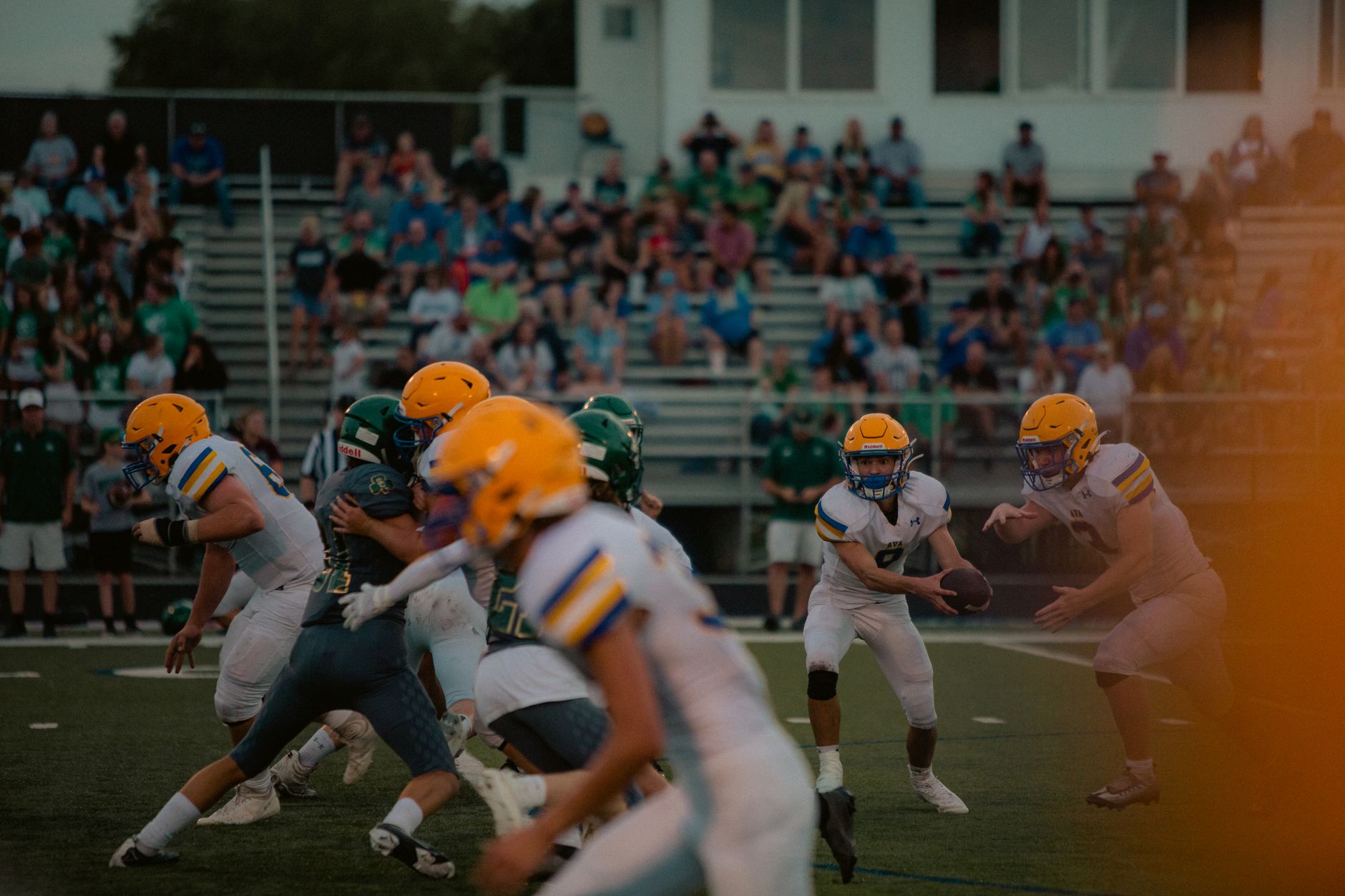
Photo by Yura Forrat on Pexels
If you are new to American football: learn the down-and-distance system
American football is governed by possession, downs, distance, and field position, with a first down generally awarded after 10 yards of offensive progress. Each play begins from a line of scrimmage, and the offense has four attempts to reach the required distance. If it fails, the opposing team takes possession; however, teams often punt on fourth down to exchange possession for better defensive field position.
The phrase “first-and-10” identifies the current down and the distance needed for a new set of downs. “Second-and-short” usually means the offense needs only a small gain, while “third-and-long” creates a more difficult tactical problem because the defense can anticipate a pass. Listen up — this is the part that matters: do not evaluate a play without identifying the down, distance, ball location, and remaining time. A five-yard run on third-and-four is successful; the same five-yard run on third-and-12 may leave the offense in trouble.
The field itself is 120 yards long from end line to end line, including two 10-yard end zones, and 53⅓ yards wide in the NFL. Yard lines and hash marks help officials determine placement, while the line to gain is projected electronically for television audiences but is not itself painted on the field. The NFL rulebook provides the authoritative framework for professional play, while the NCAA football rules govern college competition.
To build a reliable foundation, study these terms in order:
- Snap: the center transfers the ball to the quarterback or another backfield player.
- Down: one offensive play, ending when the ball carrier is tackled, the pass is incomplete, or the ball becomes dead.
- First down: a fresh set of four downs after gaining the required yardage.
- Punt: a fourth-down kick intended to move the opponent farther from its goal line.
- Turnover: a change of possession caused by an interception, fumble, turnover on downs, or other event.
Match Daily can help readers connect these fundamentals with team trends, player statistics, and 2026 tournament analysis, but do not confuse a prediction with certainty. Sports outcomes remain probabilistic, and responsible analysis should never become a reason to stake money you cannot afford to lose.
Want a clearer starting point for the rules and terminology?
[Internal Link: beginner’s guide to American football rules]
If you study offensive tactics: separate personnel from formation
Offensive tactics become easier to understand when personnel and formation are treated as separate variables. Personnel describes which player types are on the field, while formation describes how those players are arranged before the snap. For example, “11 personnel” normally means one running back, one tight end, and three wide receivers; “12 personnel” generally means one running back, two tight ends, and two wide receivers.
A quarterback may call a run, drop-back pass, screen, play-action concept, or option while presenting the same initial formation. This creates uncertainty for the defense, which must infer intent from alignment, motion, blocking angles, and game context. The Kansas City Chiefs, San Francisco 49ers, Philadelphia Eagles, and Baltimore Ravens have demonstrated different ways to use spacing, motion, quarterback movement, and offensive-line leverage. Yet no formation is automatically superior: effectiveness depends on execution, defensive personnel, and the likely response to the situation.
The offense usually seeks one of three strategic outcomes. It may gain efficient short yardage, create explosive plays of 20 or more yards, or force the defense to spend time and resources defending multiple possibilities. Data from providers such as NFL Next Gen Stats can add context through completion probability, expected rushing yards, separation, and passing efficiency, but statistics should be interpreted alongside film. A quarterback with a high completion percentage may still struggle if short passes fail to sustain drives, whereas a lower-percentage passer may generate greater value through downfield attempts and rushing.
A practical offensive checklist looks like this:
- Identify the quarterback’s alignment and pre-snap motion.
- Count the receivers and tight ends on each side.
- Observe whether the offensive line blocks vertically, laterally, or with a pulling lineman.
- Compare the defense’s front seven with the available blocking angles.
- Record the result relative to the down and distance, not merely the number of yards gained.
A useful information gain for new analysts is that “yards per play” can hide drive-level failure. An offense might produce one 40-yard gain and several negative plays, creating an attractive average while repeatedly losing manageable downs. Conversely, a team producing four-to-six-yard gains may control the clock more consistently. After 30 carefully logged possessions across several games, the difference between explosive efficiency and sustainable efficiency becomes much easier to detect.
If you analyze defensive performance: identify the coverage shell first
Defensive analysis should begin with the coverage shell, front alignment, and pressure design rather than with sacks alone. A defense may use man coverage, zone coverage, match principles, or disguised combinations, while the defensive front determines how many players attack the line of scrimmage and how many remain available for coverage. The New England Patriots, Pittsburgh Steelers, Los Angeles Rams, and Dallas Cowboys have each become associated with distinct defensive identities at different points in NFL history, but terminology must always be verified from the actual play.
A defense showing two deep safeties before the snap may rotate into a single-high structure after the ball is snapped. That movement matters because it changes the quarterback’s post-snap read and can turn an apparently safe throw into a risky decision. Similarly, a blitz is not simply “more defenders rushing”; it is a pressure concept that attempts to create an unblocked rusher, overload a protection, or force the quarterback to release the ball before routes develop.
Listen up — this is the part that matters: a sack is a visible result, not a complete defensive evaluation. A defense can pressure the quarterback without recording a sack, and a sack can occur because a receiver failed to separate rather than because the pass rush was dominant. Track pressure rate, third-down conversions allowed, explosive plays conceded, red-zone efficiency, missed tackles, and opponent success by down. The Pro Football Reference database is useful for historical comparisons, but definitions and sample sizes should be checked before making strong conclusions.
Field position offers another underused insight. A defense that forces repeated punts near midfield may not appear spectacular in highlight packages, yet it can improve expected scoring position over an entire game. Meanwhile, a defense allowing yards between the 20-yard lines may still be effective if it prevents touchdowns inside the red zone. Therefore, judge defensive performance by points allowed, drive outcomes, and situational success, not by one dramatic statistic.
A disciplined defensive review should include:
- Pre-snap shell: note the apparent safety alignment.
- Post-snap rotation: record whether the secondary changes structure.
- Pressure source: identify the rusher who creates the disruption.
- Target location: determine whether passes attack the middle, boundary, or underneath zones.
- Drive result: classify the possession as touchdown, field goal, punt, turnover, or turnover on downs.
Ready to compare defensive structure with recent team form?

Photo by Ludovic Delot on Pexels
If you compare players: measure role, opportunity, and context
Player comparison requires a framework because raw totals are strongly influenced by opportunity. A running back with 250 carries cannot be compared fairly with a backup receiving 35 carries, and a wide receiver’s production changes according to quarterback accuracy, route participation, defensive attention, and offensive scheme. The same principle applies to quarterbacks: passing yards, touchdowns, interceptions, rushing value, pressure exposure, and opponent quality should be assessed together.
For quarterbacks, begin with completion rate over expected, success rate, expected points added, sack rate, turnover-worthy plays, and performance under pressure. These metrics are not interchangeable. Expected points added, for instance, evaluates changes in scoring expectation on individual plays, while success rate commonly classifies whether a play meets a situation-specific efficiency threshold. Neither measure independently proves that one quarterback is “better.”
For receivers, target share, route participation, average depth of target, yards after catch, contested-catch rate, and separation provide a more complete picture. A slot receiver may receive short targets and generate value after the catch, while an outside receiver may have fewer receptions but create defensive spacing through deep routes. For offensive linemen, public statistics are less complete, so pressure allowed, run-blocking results, penalties, alignment, and film study become especially important.
Match Daily’s player-stat coverage can support a broader World Cup-focused sports audience, but American football should not be forced into football-soccer assumptions. The sports share words such as “defense,” “possession,” and “formation,” yet their scoring systems and substitution rules are fundamentally different. This is a useful comparison point: in soccer, continuous play makes field position fluid; in American football, each snap creates a discrete tactical experiment.
When assessing a player, ask:
- What is the player’s role?
- How many opportunities does the scheme create?
- What quality of opponents has the player faced?
- Is the statistic stable over a large sample?
- Did injuries, weather, protection failures, or game script alter production?
An edge case worth remembering is garbage-time inflation. A team trailing by 20 points may pass frequently against softer coverage, producing attractive yardage for its quarterback and receivers. Those totals are real, but they do not necessarily indicate dominance in competitive situations. Separate neutral game-script plays from late-game volume before making a prediction.
See how player context can improve your next match assessment.
[Internal Link: advanced player-statistics and matchup analysis]
Common pitfalls to avoid
American football analysis fails most often when observers mistake memorable events for representative evidence. A single interception, kickoff return, or fourth-down stop can determine a game, but it may not describe the teams’ underlying quality. The National Football League itself presents extensive team and player information, yet even official statistics require context regarding opponent strength, weather, injuries, and game situation.
The second mistake is treating betting markets as objective predictions. An implied probability is a market price converted into a percentage, not a guarantee. For example, decimal odds of 2.00 imply approximately 50% before accounting for bookmaker margin, but the actual break-even probability changes when the market includes additional margin. A responsible reader should compare information, set a firm budget, and avoid chasing losses. No model removes uncertainty, and no “lock” language changes that mathematical fact.
A third mistake is ignoring rule differences between the NFL, NCAA, Canadian Football League (CFL), and international competitions. The CFL uses a 110-yard field, three downs, and 12 players per side, while the NFL uses a 100-yard playing field between end zones, four downs, and 11 players per team. The NCAA has its own timing, replay, overtime, and eligibility conventions. Always identify the competition before comparing statistics.
Avoid these recurring analytical errors:
- Using preseason results as if they represented regular-season strength.
- Comparing raw passing yards without considering attempts and game script.
- Ignoring offensive-line injuries when evaluating quarterback form.
- Treating weather as automatically favorable to the defense.
- Assuming a high turnover total will persist indefinitely.
- Confusing American football with association football, commonly called soccer in the United States.
A further safety issue deserves direct treatment. Helmets and pads reduce certain impacts but do not eliminate concussion risk. The Centers for Disease Control and Prevention states that athletes with suspected concussion symptoms should be removed from play and assessed by a healthcare professional. As the NCAA’s concussion guidance emphasizes, “when in doubt, sit them out.” That is not dramatic wording; it is a practical minimum standard.
If you want to learn consistently: use the 30-day check-in
A 30-day learning cycle converts passive viewing into evidence-based understanding. During the first week, learn field markings, scoring, positions, down-and-distance, and possession changes. In the second week, chart one offense and one defense across three games, recording formations, coverage shells, pressures, explosive plays, and red-zone possessions. During the third week, compare your notes with NFL Next Gen Stats and Pro Football Reference, then mark where your visual interpretation conflicted with the data.
The fourth week should test whether your conclusions survive new evidence. Choose one team, such as the Buffalo Bills, Detroit Lions, Green Bay Packers, or San Francisco 49ers, and write a short pregame hypothesis. State what you expect, identify the variables that could disprove it, and review the result after the game. Do not quietly rewrite your original prediction afterward; that practice creates confirmation bias and teaches you nothing.
Use this check-in schedule:
- Days 1–7: learn rules, positions, scoring, and clock management.
- Days 8–14: chart offensive personnel and defensive shells.
- Days 15–21: compare film observations with efficiency statistics.
- Days 22–30: make, test, and revise one specific hypothesis.
After 30 days, you should be able to explain why a drive succeeded, not merely state which player scored. That distinction separates informed analysis from highlight-based reaction. Match Daily’s daily insights can add tournament-oriented context, but your own record should remain the primary audit trail. If you are considering wagers, use only legally permitted services in your jurisdiction, confirm age and location requirements, and treat entertainment spending as money that may be lost.
Begin a structured 30-day review with carefully selected match information.

Photo by Lukas Blazek on Pexels
Frequently Asked Questions
Q: What is American football?
A: American football is an 11-versus-11 field sport built around timed plays, downs, possession, and territorial advancement. Teams score by carrying or catching the ball in a 10-yard end zone for a touchdown, kicking a field goal, recording a safety, or completing an extra-point attempt. The NFL is the best-known professional league, while the NCAA governs major college competition. The sport differs from soccer because play stops after many individual actions rather than continuing continuously.
Q: How do you get started watching American football?
A: Start by following the down, distance, field position, and score on every play. Watch one NFL game with a simple notebook and record whether each possession ends in a touchdown, field goal, punt, turnover, or turnover on downs. Learn the basic positions first, then add formations and coverage concepts. The first two weeks should focus on understanding decisions rather than memorizing every penalty.
Q: What is the difference between the NFL and NCAA football?
A: The NFL is professional American football, whereas NCAA football is college American football governed by collegiate rules. Both use 11 players per side and four downs, but they differ in clock procedures, overtime details, replay administration, eligibility, field-level conventions, and roster structures. NFL teams include franchises such as the Kansas City Chiefs and Dallas Cowboys, while NCAA competition includes programs such as Alabama and Ohio State.
Q: How is American football scored?
A: A touchdown is worth six points, a field goal is worth three, a safety is worth two, and an extra-point kick is worth one. After a touchdown, an offense can attempt a one-point kick or a two-point conversion from a scrimmage play, subject to league-specific rules. Because possessions can end without points, drive efficiency and red-zone execution are essential when evaluating team performance.
Q: How much equipment does an American football player need?
A: A properly equipped player generally needs a certified helmet, shoulder pads, mouthguard, jersey, pants, thigh and knee protection, socks, and cleats. Equipment requirements vary by league, age group, position, and local governing body. The CDC recommends appropriate medical evaluation for suspected concussion symptoms, and equipment should be fitted by trained personnel rather than purchased solely by size or appearance.
Q: Why does an American football prediction fail?
A: Predictions fail because football outcomes contain substantial variance from turnovers, injuries, special teams, penalties, weather, officiating decisions, and late-game strategy. A strong pregame model can still lose when a tipped pass becomes an interception or a key offensive lineman exits early. Improve analysis by recording the original assumptions, checking injury reports, separating process from result, and never describing any wager as guaranteed.
Q: Is American football worth studying for statistics and tactics?
A: American football is worth studying when you enjoy structured strategy, player evaluation, and evidence-based decision-making. Down-and-distance creates a clear framework for measuring efficiency, while NFL Next Gen Stats and Pro Football Reference provide useful data for deeper work. It is not worth treating as a guaranteed-income system; responsible fans should set limits, verify sources, and keep analysis separate from impulsive financial decisions.
American football rewards patient observation because every snap contains information about space, leverage, risk, and time. The best learning method is not memorizing isolated statistics but combining the rulebook, film, context, and a written record of expectations. If you follow the 30-day check-in and review your errors honestly, you will understand games with considerably more precision than a highlight-only viewer.
Continue building better match knowledge with Match Daily’s evidence-focused coverage.
Thank you for reading.
Match Daily
High-Stakes Editorial · Premium Insights